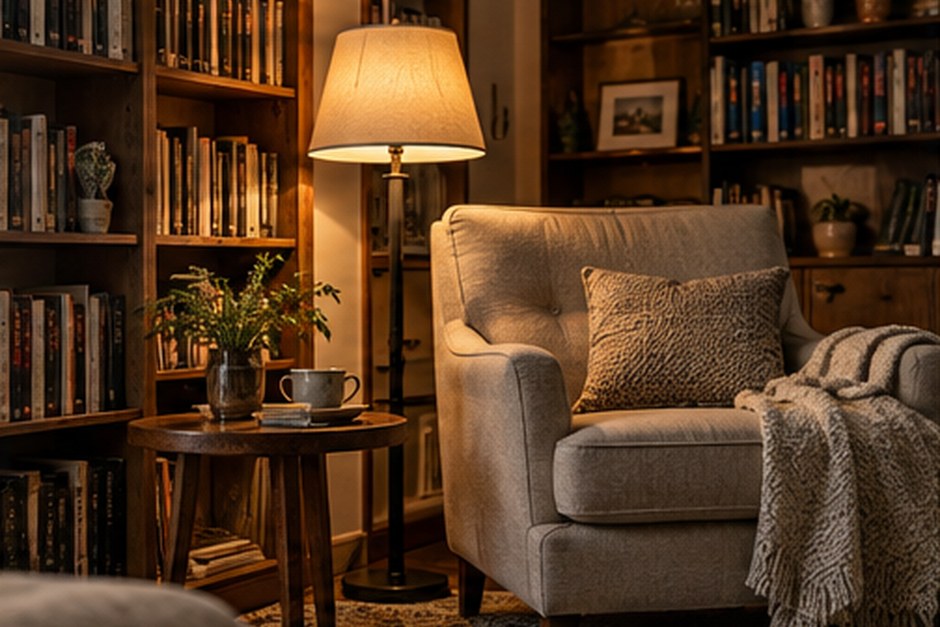
How to Build a Reading Corner You’ll Actually Use
A reading corner is one of those ideas that can look effortless in photographs and still fail in daily life. A beautiful chair in a dark corner may never be used. A shelf full of books can become decorative storage if there is nowhere comfortable to sit nearby. The most successful reading spaces are usually modest: good light, a supportive seat, a small surface, and books close enough to reach without turning the area into a project.
The first decision is location. Instead of choosing the emptiest corner of the room, notice where you naturally pause. A window with soft afternoon light, the quiet side of a living room, or the end of a bedroom can work well because these places already feel separate from busier activities.
Start with light before furniture
Natural light is pleasant during the day, but a reading corner needs a dependable lamp as well. Place the lamp so the page is illuminated from the side rather than directly behind your head. A warm, focused pool of light creates a sense of enclosure without requiring the whole room to be bright. If the chair is near a window, make sure glare does not fall directly across the page at the time you are most likely to read.
A floor lamp is useful when there is no side table. A small table lamp works well when the seat already has a nearby surface. The important point is convenience: if switching on the light requires moving furniture or hunting for an extension lead, the space will quickly lose its appeal.
Choose comfort that supports a real reading session
Deep lounge chairs are inviting, but they are not automatically comfortable for reading. Pay attention to back support, arm height, and whether your feet can rest naturally. A chair that allows you to change position is often more useful than one that looks sculptural but fixes the body in a single pose.
A throw can make a corner feel warmer and is genuinely useful in cooler months. One small cushion can help adjust lower-back support. Beyond that, more accessories are optional. Leaving some visual space around the chair makes the corner easier to enter and keeps it from becoming another storage zone.
Keep a small, changing selection of books nearby
There is no need to move an entire library next to the chair. A short shelf, basket, or stack of four or five books can be more inviting because it reduces choice. Keep one current book, something easy to browse, and perhaps one title you want to start next. When you finish or lose interest, rotate the selection.
This approach also prevents the reading corner from becoming static décor. The objects around it change with what you are actually reading, so the space continues to reflect daily use rather than a finished display.
Add one surface and protect it from clutter
A small side table should have enough room for a mug, glasses, and a book. That is usually enough. If the surface becomes a permanent landing zone for keys, chargers, receipts, and unopened mail, the reading area begins to feel like the rest of the room. Keeping the table intentionally limited is one of the easiest ways to preserve the corner’s purpose.
If space is tight, a wall-mounted shelf or narrow stool can do the same job. The point is not the furniture type but the ability to put something down without getting up.
Make starting easier than postponing
A reading corner becomes useful when it reduces friction. Leave a bookmark in the current book, keep the lamp ready, and choose a seat that is not buried under laundry or cushions. Ten minutes with a book after breakfast or before bed is enough to establish the space as part of a routine.
Over time, the most satisfying reading corners are rarely the most elaborate. They are the places where everything necessary is within reach and nothing asks for attention first. A chair, a light, a small table, and a few books can be enough to create a room within a room.