Five Small Experiments to Calm Your Kitchen Counter
A calm kitchen counter doesn’t appear by accident. It’s the result of a few small adjustments practiced until they become second nature. Below are five brief experiments you can try over the course of a week. Each one is short, focuses on a single outcome, and points out common mistakes with practical corrections. Treat them as mini-checklists: try one, notice the difference, then move to the next.
Experiment 1 — The 5-Minute Evening Sweep
Goal: End the day with only everyday items left on the counter.
- Set a timer for five minutes after dinner.
- Clear dishes, wipe crumbs, and put away any single-use items (mugs, scrubbers, mail).
- Designate a single small spot as the “drop zone” for keys or a wallet; move everything else.
Common mistakes
- Trying to deep-clean everything each night. This leads to avoidance.
- Using the counter as a long-term dumping ground for mail or random tools.
Correction
Keep the sweep short and repeatable. If an item doesn’t belong in the kitchen, put it away immediately or place it in a small basket labeled “relocate tomorrow” to avoid nightly overwhelm.
Experiment 2 — The One-Item Home Test
Goal: Help frequently used objects find a consistent home.
- Pick one object that often wanders across the counter (a can opener, a jar opener, a phone charger).
- Decide on one logical place for it (a drawer, a hook, a designated tray).
- For three days, return that object immediately after use.
Common mistakes
- Choosing a home that’s inconvenient. If returning feels like a chore, you won’t do it.
- Putting the item out of sight where you then forget it.
Correction
Choose a home that balances visibility and tidiness—nearby but tidy. The small ritual of returning one item builds muscle memory that scales up.
Experiment 3 — The Three-Zone Day
Goal: Make the counter’s purpose visible through simple zoning.
- Divide one stretch of counter into three zones: Prep (near the stove), Landing (near the entry), and Display (a small decorative corner).
- For one day, allow only items that belong to each zone to sit there.
- Note which items keep migrating and why.
Common mistakes
- Creating too many zones or making them too large; that leads to blurred purpose.
- Treating the Display zone like storage instead of intentional decor.
Correction
Keep zones minimal and functional. If something consistently lands outside its zone, either change the zone or find a new home for the item.
Experiment 4 — The Two-Thing Rule
Goal: Limit visual clutter while keeping the counter useful.
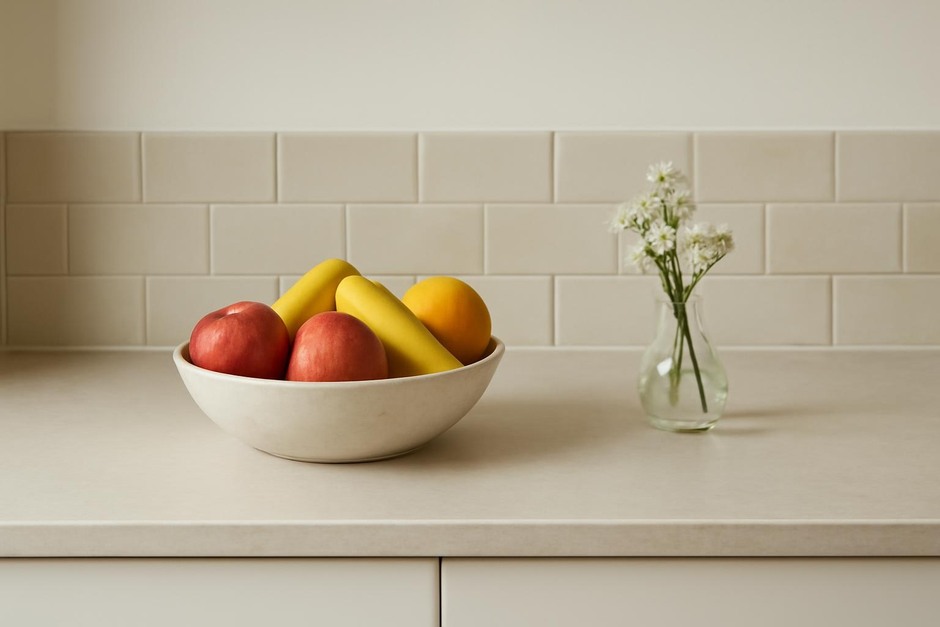
- Choose a countertop area and allow only two things to remain on it by default—one functional (a cutting board) and one small decorative (a bowl of fruit, a vase).
- Rotate the decorative item weekly so the space feels fresh without accumulating objects.
Common mistakes
- Thinking the rule is a ban on usefulness. It’s not—it’s selective.
- Overfilling the decorative slot with many small objects.
Correction
Choose items that are both pleasing and functional where possible. A single wooden board and a small bowl can be both useful and calming.
Experiment 5 — The 15-Minute Weekly Reset
Goal: Prevent accumulated clutter from becoming a project.
- Pick a consistent 15-minute slot once a week—no tools needed except a timer and a bag for recycling.
- Sort counter items into: keep in place, relocate, recycle/clean.
- Wipe the surface and briefly assess whether any item needs a new, permanent home.
Common mistakes
- Letting the reset become a once-a-month marathon instead of a weekly habit.
- Using the reset to “decide later,” which reintroduces indecision.
Correction
Timebox the task and make quick decisions. If an item still feels hard to place, give it a temporary home and schedule a 10-minute follow-up to find a better solution.
Closing Notes
Each experiment trains a specific skill: nightly closure, consistent return, purposeful zoning, disciplined selection, and regular maintenance. Try them in sequence or pick the one that feels most approachable. After a week, reflect on what changed—what was easier, what resisted change, and which small correction made the biggest difference. These quiet experiments, repeated gently, build the habit of a calm and useful kitchen counter.